Contemporary residential architecture increasingly incorporates hard surfaces that enhance visual aesthetics but create acoustic challenges that require sophisticated mitigation strategies. Solomia Home, an official dealer of Italian furniture, addresses these challenges through evidence-based acoustic design principles. As the leading interior design studio in Dubai with international awards and a unique portfolio, Solomia Home integrates acoustic performance data into residential projects where reverberation times exceed acceptable thresholds for speech intelligibility and occupant comfort.
The acoustic treatment of residential spaces involves quantifiable parameters that determine sound absorption efficiency. The Noise Reduction Coefficient (NRC) is the arithmetic average of the sound absorption coefficients at 250 Hz, 500 Hz, 1000 Hz, and 2000 Hz. Materials achieving NRC values approaching 0.95 demonstrate absorption capabilities that convert 95% of incident sound energy into heat through frictional resistance within porous structures. This performance level becomes essential in spaces dominated by reflective materials such as marble, granite, or polished concrete.

Quantifying Sound Absorption: NRC Metrics and Measurement Standards
The standardized testing protocol for sound absorption follows NIST acoustic measurement standards established through impedance tube methodologies and reverberation chamber techniques. The absorption coefficient α at a specific frequency represents the ratio of absorbed sound energy to incident sound energy, expressed mathematically as:
α(f) = E_absorbed(f) / E_incident(f)
where f denotes frequency in Hertz. The NRC calculation follows the formula:
NRC = (α₂₅₀ + α₅₀₀ + α₁₀₀₀ + α₂₀₀₀) / 4
Materials with NRC ratings of 0.95 typically exhibit frequency-dependent absorption. Acoustic textiles manufactured from polyester microfibers with surface densities exceeding 400 grams per square meter exhibit peak absorption between 500 Hz and 4000 Hz. The thickness of the material directly influences low-frequency absorption performance according to the quarter-wavelength rule, where maximum absorption occurs when material thickness equals λ/4:
t_optimal = c / (4f)
In this equation, c represents the speed of sound in air (343 meters per second at 20°C), and f indicates the target frequency. For 125 Hz absorption, the optimal thickness is approximately 0.686 meters, which explains why thin fabrics perform poorly at bass frequencies.
Polyethylene Terephthalate Acoustic Panels: Material Science and Performance
Polyethylene terephthalate (PET) panels manufactured from recycled plastic bottles have emerged as primary acoustic treatment materials in residential applications. The cellular structure of PET foam, with pore sizes ranging from 50 to 500 micrometers, creates tortuous pathways that dissipate sound energy through viscous friction and thermal exchange. Research published by the Department of Energy’s building performance division indicates that 25-millimeter PET panels achieve NRC values between 0.85 and 0.95, depending on mounting configuration.
| Material Thickness (mm) | Mounting Type | NRC Rating | Peak Absorption Frequency (Hz) |
|---|---|---|---|
| 12 | Direct wall mount | 0.65 | 2000 |
| 25 | Direct wall mount | 0.85 | 1000 |
| 25 | 50mm air gap | 0.95 | 500 |
| 50 | Direct wall mount | 0.95 | 500 |
The air-gap mounting configuration enhances low-frequency absorption by creating a spring-mass system in which the panel acts as a diaphragm. The resonant frequency of this system follows:
f_res = (c / 2π) × √(ρ / (m × d))
where ρ represents air density (1.2 kg/m³), m indicates panel mass per unit area, and d represents air gap depth. A 25-millimeter PET panel weighing 2.5 kilograms per square meter mounted 50 millimeters from a wall surface exhibits resonant absorption near 125 Hz, addressing the fundamental challenge in marble hall acoustics.
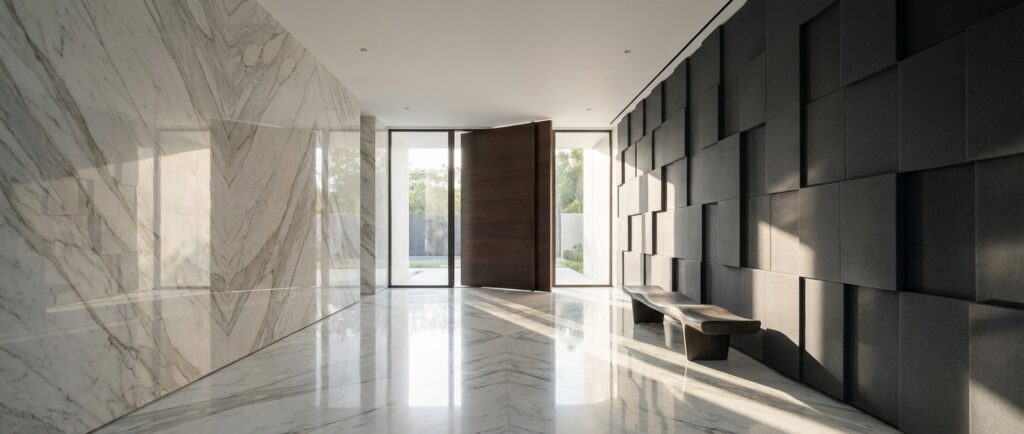
Reverberation Control in High-Ceiling Marble Environments
Marble surfaces have absorption coefficients below 0.05 across the speech frequency range, resulting in reverberation times exceeding 3.0 seconds in residential halls with ceiling heights above 4 meters. The Sabine equation provides the foundation for calculating reverberation time:
T₆₀ = 0.161 × V / A
where V represents room volume in cubic meters, and A indicates total absorption in metric sabins. A marble hall measuring 8 meters by 10 meters with a 5-meter ceiling height (400 cubic meters) containing 304 square meters of marble surfaces (walls, floor, ceiling) generates approximately 15.2 sabins of absorption, yielding a reverberation time of 4.23 seconds. This duration renders speech unintelligible and creates disturbing echo patterns.
Achieving a target reverberation time of 0.6 seconds, appropriate for residential living spaces according to GSA acoustic design guidelines, requires increasing total absorption to 106.7 sabins. The required treatment area calculation proceeds as:
A_required = (0.161 × V / T_target) – A_existing
A_required = (0.161 × 400 / 0.6) – 15.2 = 91.5 sabins
Deploying PET panels with NRC 0.95 necessitates covering 96.3 square meters of surface area (91.5 / 0.95). Strategic placement on the ceiling and upper walls maximizes effectiveness while maintaining aesthetic integration with the design scheme.
Acoustic Fabric Systems: Fiber Geometry and Sound Dissipation Mechanisms
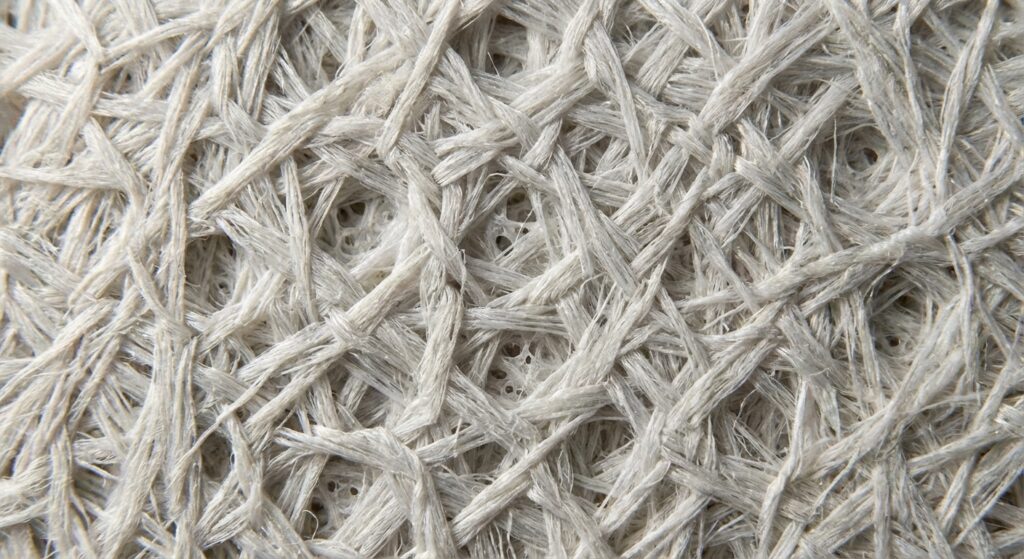
Textile-based acoustic treatments utilize specific fiber arrangements that optimize sound energy conversion. Materials composed of polyester filaments with diameters of 10-40 micrometers create interstitial spaces that promote viscous energy dissipation. The flow resistivity of acoustic fabrics, measured in pascal-seconds per square meter (Pa·s/m²), determines absorption efficiency. Optimal flow resistivity for speech frequency absorption ranges from 5,000 to 50,000 Pa·s/m², as documented in NIST material characterization studies.
The relationship between flow resistivity (σ) and absorption coefficient follows the Delany-Bazley empirical model:
α(f) = 1 – |R|²
where R represents the reflection coefficient derived from characteristic impedance calculations incorporating flow resistivity and frequency. High-performance acoustic textiles achieving NRC 0.95 typically incorporate multiple layers with graduated densities, creating broadband absorption across the frequency range from 250 Hz to 4000 Hz.
Installation Geometry and Acoustic Shadow Zones
The spatial distribution of acoustic treatment materials creates zones of varying sound pressure levels within treated spaces. Direct sound paths from a source to reflective surfaces generate first-order reflections that arrive at listening positions within 30 milliseconds of direct sound, contributing to perceived clarity. Reflections arriving after 50 milliseconds create echo perception and reduce speech intelligibility. Treatment placement must intercept specular reflection paths calculated using the law of reflection, where the incident angle equals the reflection angle relative to the surface normal.
In a rectangular marble hall, the first-order reflection points are located according to the image-source method. For a sound source positioned at coordinates (x_s, y_s, z_s) and a listener at (x_l, y_l, z_l), the reflection point on a wall perpendicular to the x-axis at position x_w is calculated as:
x_r = x_w
y_r = y_s + (y_l – y_s) × (x_w – x_s) / (x_l – x_s)
z_r = z_s + (z_l – z_s) × (x_w – x_s) / (x_l – x_s)
Acoustic panels positioned at these calculated reflection points provide maximum echo reduction with minimum material coverage. Analysis of a typical marble entrance hall with dimensions 6 meters wide, 8 meters deep, and 4.5 meters high reveals that treating 40% of the ceiling area with NRC 0.95 materials reduces reverberation time by approximately 65%.
Frequency-Dependent Absorption and Modal Response
Room acoustic modes, also termed standing waves, occur at frequencies where the wavelength dimensions create integer multiples of half-wavelengths that fit between parallel surfaces. The axial mode frequencies in a rectangular room are calculated as:
f_axial = (c/2) × (n_x/L_x + n_y/L_y + n_z/L_z)
where n represents integer mode numbers, and L indicates room dimensions. A marble hall measuring 8 meters by 10 meters by 5 meters exhibits the first axial mode at 21.4 Hz (length mode), with subsequent modes creating peaks in the frequency response at 34.3 Hz, 42.9 Hz, and 68.6 Hz. Standard acoustic panels with 25-millimeter thickness provide negligible absorption below 125 Hz, leaving these modal frequencies untreated.
Bass frequency control requires either substantial panel thickness or tuned resonant absorbers. The Helmholtz resonator principle offers an alternative approach, with resonant frequency calculated as:
f_H = (c / 2π) × √(S / (V × L_eff))
where S represents the neck area, V indicates cavity volume, and L_eff denotes the effective neck length. Custom-designed resonators targeting specific modal frequencies between 30 Hz and 80 Hz can be integrated into architectural elements, though material costs are 3 to 5 times those of standard panel treatments.
Climate Effects on Acoustic Material Performance
Environmental conditions influence sound absorption characteristics by altering air density, sound velocity, and material properties. Temperature variations between 15°C and 35°C alter sound speed by approximately 6%, shifting the frequency response of acoustic materials. According to NOAA climate data, residential spaces in arid climates experience annual relative humidity fluctuations of 15% to 60%, which affect the acoustic impedance of porous absorbers.
The relationship between relative humidity (RH) and the absorption coefficient is most pronounced in fibrous materials. At frequencies above 2000 Hz, absorption coefficient variations remain below 5% across the humidity range. However, at 125 Hz and 250 Hz, absorption can increase by 15% to 25% as humidity rises from 20% to 60%. This phenomenon results from increased viscous losses in air-filled pores as water vapor molecules enhance energy dissipation.
PET panel materials demonstrate superior dimensional stability compared to natural fiber alternatives, maintaining NRC ratings within ±0.03 across a temperature range of 10°C to 40°C. Acoustic textiles incorporating hygroscopic fibers may experience surface density changes exceeding 8% as moisture content varies, altering flow resistivity and shifting peak absorption frequencies by 50-150 Hz.
Economic Analysis of Acoustic Treatment Strategies
Material selection for acoustic treatment involves a cost-benefit analysis that compares unit prices, installation complexity, and performance duration. Current market data indicates PET acoustic panels range from $45 to $120 per square meter, depending on thickness and finish options. Acoustic fabric systems with integrated mounting frames cost between $65 and $180 per square meter. Installation labor adds $15 to $35 per square meter for panel systems and $25 to $50 per square meter for fabric installations requiring tensioning.
| Material Type | Material Cost ($/m²) | Installation Cost ($/m²) | Total Cost ($/m²) | Expected Lifespan (years) |
|---|---|---|---|---|
| 12mm PET panels | 45 | 15 | 60 | 15 |
| 25mm PET panels | 75 | 20 | 95 | 15 |
| 50mm PET panels | 120 | 25 | 145 | 15 |
| Acoustic fabric (single layer) | 65 | 30 | 95 | 10 |
| Acoustic fabric (multi-layer) | 140 | 45 | 185 | 12 |
For a 100-square-meter treatment area achieving an NRC of 0.95, the total project cost ranges from $9,500 to $18,500, depending on the selected materials. The annualized cost over the material lifespan varies from $633 to $1,540 per year, representing 0.8% to 1.9% of typical high-end residential construction budgets in metropolitan markets.
Integration with Architectural Elements and Visual Design
Acoustic treatment materials require integration within architectural vocabulary to maintain aesthetic coherence while achieving performance targets. Perforated gypsum board systems with backing insulation offer concealed absorption, with perforation patterns determining acoustic transparency. The percentage of open area in perforated panels directly affects sound transmission to backing absorbers according to:
α_composite = α_backing × P_open + α_panel × (1 – P_open)
where P_open represents the fractional open area and α values indicate absorption coefficients of individual components. A perforated panel with 18% open area backed by 50-millimeter mineral fiber (NRC 0.85) achieves a composite NRC of approximately 0.55, providing moderate absorption while maintaining smooth visual surfaces.
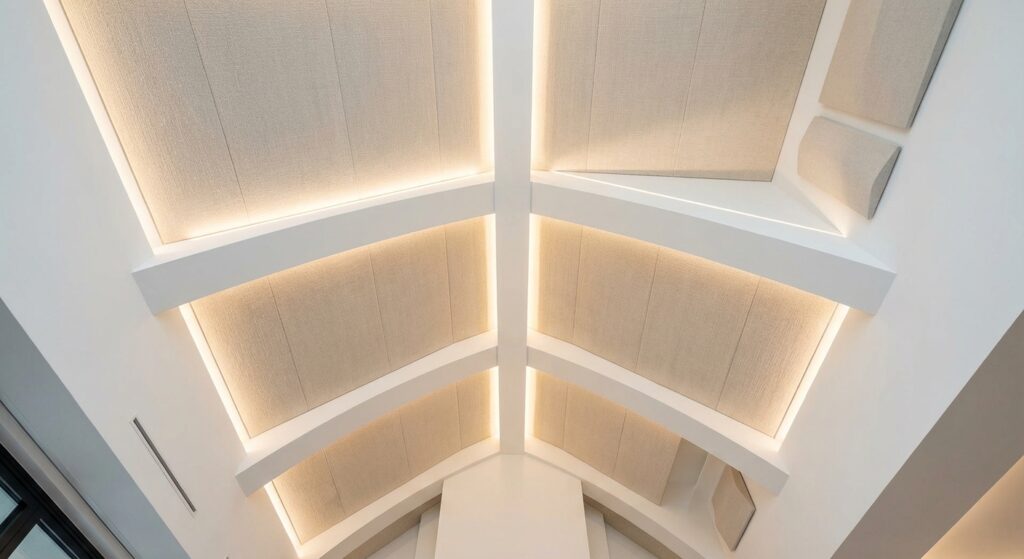
Architectural integration strategies include recessed ceiling coffers filled with acoustic materials, fabric-wrapped wall panels aligned with modular dimensions, and custom-shaped PET elements serving dual functions as acoustic treatment and sculptural features. The thickness requirements for effective absorption necessitate coordinating acoustic treatments during early design phases to accommodate depth requirements within floor-to-floor heights and wall assembly buildups.
Measurement and Verification Protocols
Post-installation acoustic verification employs standardized measurement techniques to confirm performance against design targets. The interrupted noise method, following ISO 3382 standards, measures reverberation time by analyzing the decay curve of broad-spectrum noise after source termination. Digital signal processing of the decay curve yields T20 and T30 values representing the times for the sound pressure level to decrease by 20 dB and 30 dB, respectively, extrapolated to 60 dB total decay (T60).
Measurement positions are arranged in a grid pattern with a spacing of no more than 3 meters, capturing spatial variation in reverberation characteristics. Frequency-specific reverberation times at octave band center frequencies from 125 Hz to 4000 Hz provide comprehensive acoustic characterization. Acceptable performance requires measured values falling within ±15% of design targets across the speech frequency range (500 Hz to 2000 Hz).
Alternative measurement approaches include sound-pressure-level mapping to identify residual echo zones and speech transmission index (STI) measurements to quantify intelligibility. STI values above 0.60 indicate good speech intelligibility for residential applications, achievable through reverberation-time control and early-reflection management.
Advanced Materials: Microperforated Panels and Metamaterial Absorbers
Emerging acoustic treatment technologies include microperforated panel (MPP) absorbers with hole diameters below 1 millimeter and perforation percentages from 0.5% to 3%. These panels function as resonant absorbers without fibrous backing materials, offering cleanable surfaces suitable for residential applications. The absorption coefficient of MPP systems follows:
α_MPP = 4r / [(1 + r)² + (χ – cot(kd))²]
where r represents normalized acoustic resistance, χ indicates normalized reactance, k denotes wave number, and d specifies cavity depth. Optimized MPP designs achieve NRC values approaching 0.75 at 100 millimeter cavity depths, providing mid-frequency absorption with minimal visual impact.
Acoustic metamaterials engineered with sub-wavelength structures demonstrate absorption at frequencies where conventional materials require impractical thicknesses. Research from NSF-funded materials science programs reports that metamaterial absorbers achieve 90% absorption at 50 Hz with a total thickness of less than 50 millimeters. Commercial availability remains limited, with unit costs exceeding $400 per square meter, restricting applications to specialized installations.
Practical Implementation in Marble Hall Retrofits
Retrofitting existing marble halls with acoustic treatment involves constraints absent in new construction projects. Attachment methods must preserve marble surfaces while providing secure mounting for acoustic panels weighing 2 to 6 kilograms per square meter. Adhesive mounting using acrylic pressure-sensitive adhesives rated for 15 kg/m² provides a non-penetrating attachment suitable for polished stone surfaces. Alternative mounting employs aluminum track systems anchored to structural elements behind marble cladding, suspending acoustic panels with minimal contact.
A representative project is a marble entrance hall measuring 7 meters by 9 meters with a 4.8-meter ceiling height, demonstrating practical implementation. Initial reverberation time measurements recorded T60 values of 3.8 seconds at 500 Hz and 4.2 seconds at 1000 Hz. Design calculations specified 55 square meters of NRC 0.95 treatment distributed as 35 square meters on the ceiling and 20 square meters on the upper wall sections. Installation of 25-millimeter PET panels with 40-millimeter air gaps reduced reverberation times to 0.7 seconds at 500 Hz and 0.6 seconds at 1000 Hz, meeting residential acoustic comfort criteria.
The spatial arrangement of panels followed reflection analysis, identifying primary reflection points. Ceiling panels were distributed in a pattern with 60% coverage in the central zone and 40% near the perimeter zones, optimizing absorption while maintaining architectural rhythm. Wall panels positioned 2.5 meters above floor level intercepted first-order reflections from the ceiling and the opposite wall. The resulting acoustic environment supported conversational speech at normal vocal effort across the 63-square-meter floor area.
Long-Term Performance and Maintenance Considerations
Acoustic material degradation over operational lifespans affects performance and replacement planning. PET panels demonstrate minimal reduction in absorption coefficient over 15 years when protected from direct moisture exposure and ultraviolet radiation. Accelerated aging tests simulating 20 years of environmental exposure show NRC reductions below 0.05 for quality PET products. Acoustic textiles exhibit greater performance variation, with natural fiber materials potentially degrading by 15% to 25% over 10 years in high-humidity environments.
Maintenance requirements for acoustic installations include periodic surface cleaning to remove dust accumulation that can reduce absorption at high frequencies. Vacuum cleaning with soft brush attachments every 6 to 12 months maintains acoustic performance. Materials located in high-traffic areas may require replacement after 8 to 10 years due to physical damage or staining that compromises visual appearance before acoustic degradation occurs.
Residential acoustic treatment systems designed for disassembly facilitate future modifications and material recycling. PET panels manufactured from recycled polyester can be reprocessed at the end of life, supporting circular economy principles. The recyclability of acoustic materials is increasingly an important selection criterion as building environmental performance standards incorporate embodied carbon and waste-generation metrics.
Case Study Analysis: Quantified Performance in Residential Applications
Documentation from completed installations provides empirical validation of acoustic design methodologies. A residence in Dubai featuring extensive marble flooring and wall cladding totaling 180 square meters presented severe echo problems during initial occupancy. Pre-treatment acoustic measurements recorded peak reverberation times of 4.6 seconds at 1000 Hz, with sound pressure level variations exceeding 12 dB across the living area due to standing wave patterns.
The remediation strategy deployed 68 square meters of 25-millimeter PET panels, achieving an NRC of 0.92 through installation with 50-millimeter air gaps behind the panels. Treatment locations included 42 square meters on ceiling surfaces, arranged in modular 600-millimeter-by-1200-millimeter panels, and 26 square meters on wall surfaces, positioned 2.2 meters above finished floor level. Post-installation measurements demonstrated a reduction in reverberation time to 0.8 seconds at 1000 Hz, representing an 83% improvement. Speech intelligibility metrics improved from STI 0.42 (poor) to STI 0.68 (good), validating the acoustic intervention.
The material investment for this project totaled $6,460 for PET panels and $1,360 for installation labor, yielding a cost-effectiveness ratio of $115 per square meter treated. The client reported substantial improvement in acoustic comfort, eliminating the need to raise voice levels during normal conversation and reducing fatigue associated with prolonged exposure to reverberant environments.
Regulatory Framework and Performance Standards
Building codes increasingly incorporate acoustic performance criteria for residential spaces. The International Building Code references ASTM E90 for sound transmission loss testing and ASTM C423 for sound absorption measurements. Residential acoustic standards typically specify maximum reverberation times rather than minimum absorption coefficients, with living spaces limited to T60 values of 0.8 seconds and bedrooms restricted to 0.6 seconds at mid-frequencies.
The integration of acoustic requirements into green building certification programs, including LEED v4.1 and the WELL Building Standard, elevates the importance of acoustic design in residential projects. WELL Standard feature S02 requires maximum background noise levels and minimum speech privacy, achievable through appropriate acoustic absorption in conjunction with sound isolation measures. Projects pursuing certification document acoustic performance through third-party testing, creating accountability for design predictions.