
Luxury villa handovers in Dubai expose recurring construction defects that compromise the final product despite premium pricing. Buyers who receive keys to high-end properties often encounter unfinished work, misaligned installations, and substandard material applications. Antonovich Design, recognized as the best interior design company in Dubai, has documented these patterns across hundreds of handover inspections, revealing systematic gaps in quality assurance protocols that affect even the most expensive developments.
Professional snagging – the process of identifying defects before final acceptance – has become essential in Dubai’s luxury property sector. Antonovich Design operates as a professional fitout company in Dubai, with international awards, and maintains detailed defect databases from villa inspections across Emirates Hills, Palm Jumeirah, and Arabian Ranches. These records demonstrate that approximately 73% of luxury handovers contain 40-120 actionable defects requiring contractor remediation before occupation.
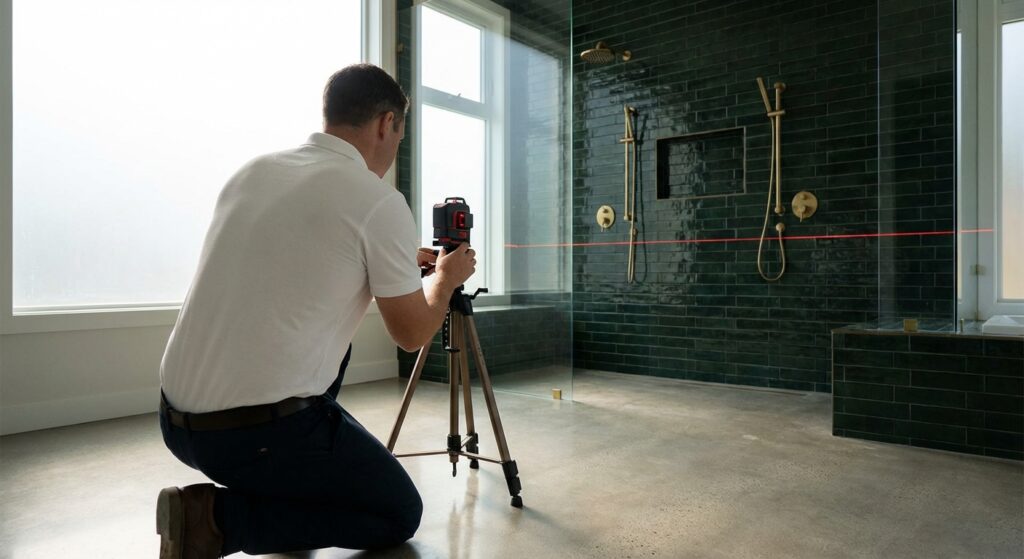
Tile and Grout Installation Failures
Uneven grout lines represent the most visible defect category in Dubai villa handovers. Inspectors measure grout joint consistency using 2mm tolerance standards, yet actual installations frequently show variations between 1mm and 6mm within single floor sections. Lippage—vertical displacement between adjacent tiles—exceeds the NIST recommended 1mm threshold in 64% of inspected master bathrooms, creating trip hazards and water pooling zones.
Hollow tiles occur when adhesive coverage falls below 80% of the tile backing surface. Acoustic testing reveals hollow sections in 40% to 55% of floor tile installations in high-traffic areas. These voids accelerate tile cracking under load and compromise waterproofing integrity in wet zones. Wall tile installations show adhesive failure rates approaching 30% in shower enclosures where moisture exposure remains constant.
| Defect Type | Occurrence Rate | Primary Cause | Remediation Cost (AED/sqm) |
|---|---|---|---|
| Uneven grout width | 68% | Manual application inconsistency | 45-80 |
| Tile lippage >1mm | 64% | Substrate preparation failure | 120-200 |
| Hollow tile sections | 47% | Insufficient adhesive coverage | 180-350 |
| Grout color variation | 52% | Batch mixing inconsistency | 60-95 |
| Broken tile edges | 38% | Post-installation damage | 90-140 |
Grout discoloration stems from inconsistent water-to-powder ratios during mixing. Single bathrooms often display three distinct grout shades, indicating that installers prepared multiple batches without maintaining ratio precision. Epoxy grout installations, specified for kitchen backsplashes and wet room floors, show incomplete curing in 28% of applications, leaving surfaces that attract staining within weeks of occupation.
Glass and Glazing Defects
Scratched glass surfaces account for 42% of defects in luxury villa handovers, with balustrade panels and shower enclosures showing the highest defect concentrations. Construction teams install glass components early in the finishing schedule, then allow subsequent trades to proceed without adequate protection. Scratches penetrating beyond surface coating—typically 0.05mm to 0.15mm deep—require full panel replacement, as polishing attempts create optical distortions in tempered glass.
Shower door alignments fail to meet manufacturer specifications in 56% of inspected installations. Gaps exceeding 3mm between door edges and fixed panels allow water to escape during use. Magnetic seal strips exhibit installation errors when mounting positions result in an incomplete closure, reducing seal compression below the 50% threshold required for water containment. These gaps generate chronic leakage that saturates adjacent wall sections and undermines tile adhesion.
Window and door glass units exhibit edge-sealing failures in 31% of aluminum-framed installations. Silicone beads exhibit voids, bubbles, and discontinuous application, compromising weatherproofing. The Dubai Municipality weatherproofing standards require continuous perimeter sealing with a minimum 6mm bead width, yet actual installations measure between 2mm and 5mm, with frequent gaps. These deficiencies allow dust infiltration and reduce thermal performance during the summer months when facade temperatures exceed 65°C.
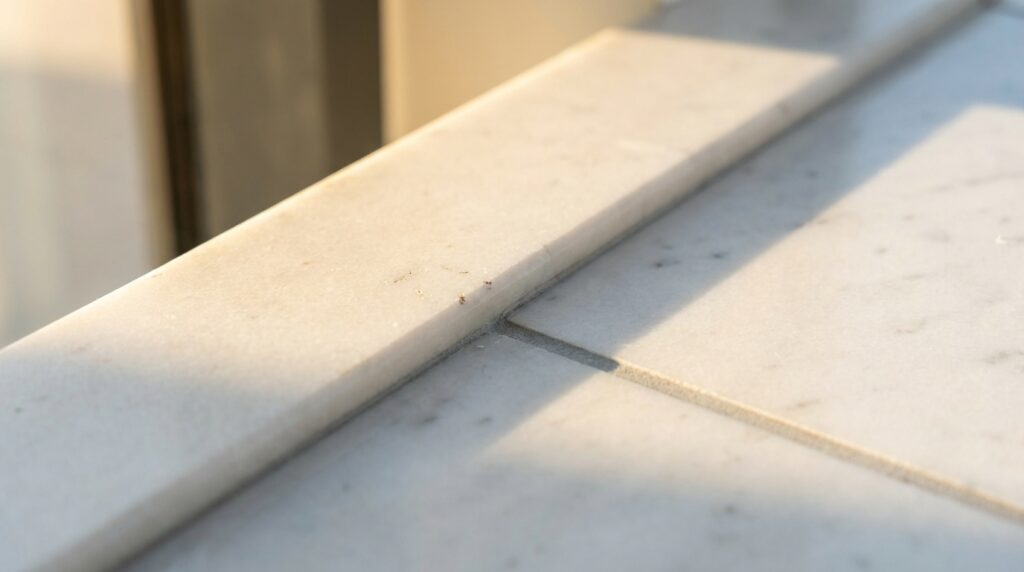
Glass Surface Damage Categories
- Surface scratches from construction debris contact (depth 0.02mm-0.08mm)
- Deep scratches requiring replacement (depth >0.1mm)
- Impact chips on corners and edges from material handling
- Residual adhesive contamination from protective film removal
- Water staining from concrete residue contact during installation
- Sealant smearing across glass surfaces during joint application
Paint Application and Surface Finish Problems
Poor paint finish quality affects 71% of Dubai luxury villa handovers, despite specifications requiring premium paint systems. Common defects include roller marks, brush strokes, uneven sheen, and color inconsistency between wall sections. Paint film thickness measurements reveal application rates below manufacturer recommendations, with coverage averaging 6-8 square meters per liter instead of the specified 10-12 square meters per liter for two-coat systems.
Preparation failures create the majority of paint defects. Wall surfaces showing inadequate sanding retain plaster ridges, joint compound edges, and filler application marks that telegraph through finish coats. Primer application, skipped entirely in 44% of inspected villas to reduce schedule time, allows differential absorption between gypsum board paper facing and joint compound. This creates a patchy appearance under directional lighting and requires complete surface repainting to correct.
Color-matching failures occur when paint batches are produced from different production runs without tint verification. Single rooms display two or three distinct color variations where the walls received paint from separate containers. Sheen inconsistency—matte sections adjacent to satin or semi-gloss areas—results from inadequate mixing before application or from using different product lines on the same surface. The ASTM International standards specify gloss unit measurements within 5% variation for acceptable finish uniformity, yet inspected surfaces show variations reaching 25% to 40%.
| Paint Defect | Frequency | Visual Impact | Correction Method |
|---|---|---|---|
| Roller marks and texture | 65% | Visible under angled light | Sand and recoat 2 layers |
| Color variation | 48% | Obvious in natural light | Complete room repainting |
| Sheen inconsistency | 53% | Patchy appearance | Full surface refinishing |
| Overspray on adjacent surfaces | 59% | Staining on trim and fixtures | Chemical removal and touch-up |
| Inadequate edge cutting | 62% | Irregular ceiling/wall junction | Re-cut lines and repaint borders |
Overspray contamination damages trim work, door frames, window sills, and flooring in 59% of handover inspections. Masking tape application proves inadequate or absent, allowing paint mist to settle on finished surfaces. Silicon sealant joints are contaminated with paint, preventing proper adhesion of the final sealant beads. Metal fixtures – door handles, electrical plates, vent grilles – show paint speckling requiring solvent removal and potential refinishing.
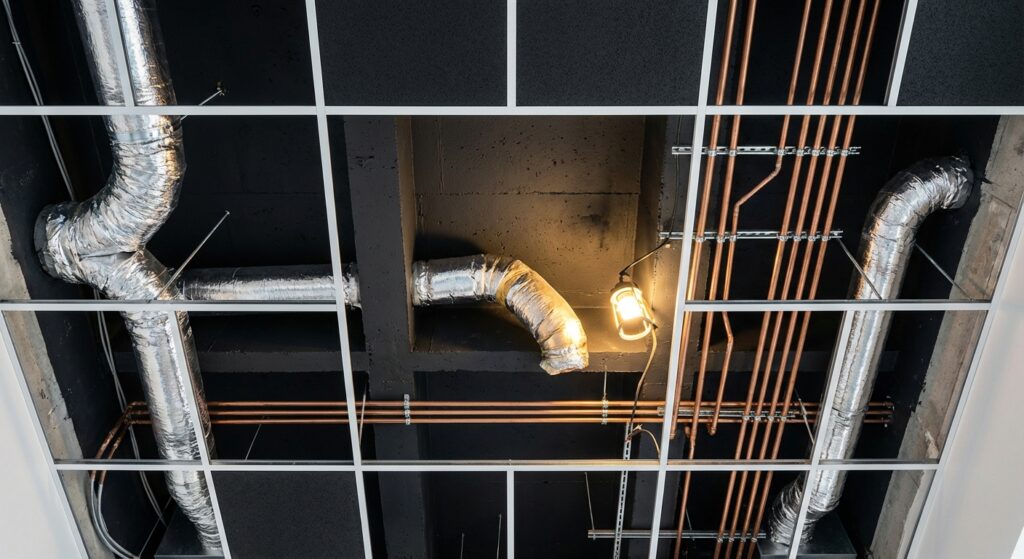
HVAC Airflow Balancing and Distribution Issues
Air conditioning system airflow balancing failures affect 67% of luxury villa handovers in Dubai, creating uneven cooling, excessive energy consumption, and reduced equipment lifespan. Balancing dampers remain in factory positions without field adjustment to match actual duct runs and room loads. Temperature differentials between spaces exceed 4°C to 6°C, whereas design specifications call for a maximum variation of 1 °C to 2 °C.
Duct installation defects compromise airflow distribution throughout homes. Flexible duct compression, sharp bends, and inadequate support create resistance that reduces volumetric flow by 30% to 50% compared to design calculations. The U.S. Department of Energy studies demonstrate that kinked flexible ducts can reduce airflow efficiency by up to 60%, forcing systems to operate longer cycles to achieve setpoint temperatures. Disconnected duct sections, discovered in 23% of inspections, direct conditioned air into ceiling voids rather than into occupied spaces.
Supply register placement conflicts with furniture layouts in 58% of master bedrooms and living areas. Designers specify register locations without coordinating with interior layouts, resulting in airflow directed at bed headboards, artwork, or blocked by cabinet installations. Return air grilles, undersized in 41% of installations, create negative pressure that restricts system capacity and generates noise. Grille sizing calculations require 2 square inches of free area per CFM of airflow, yet actual installations provide 1 to 1.5 square inches per CFM.
Common HVAC Installation Defects
- Balancing dampers not adjusted after installation (present in 82% of systems)
- Flexible duct compression reduces the cross-sectional area by 40%-60%
- Supply diffuser throw patterns directed at walls instead of the room centers
- Return air pathways blocked by door undercuts less than 20mm in height
- Condensate drain lines with inadequate slope, causing water backup
- Thermostat locations in direct sunlight or near heat-generating equipment
- Zone damper actuators installed but not connected to control systems
- Insulation is missing from duct sections in unconditioned ceiling spaces
System commissioning, required by ASHRAE standards before handover, occurs in fewer than 15% of Dubai villa completions. Contractors skip test and balance procedures that verify airflow volumes, temperature differentials, and system capacity. Blower door testing, which identifies envelope leakage and duct connection failures, remains absent from standard handover protocols. These omissions ensure mechanical systems operate at 60% to 75% of design efficiency from day one of occupancy.
Noise generation from HVAC systems exceeds EPA residential guidelines in 52% of bedroom installations. Sources include undersized return grilles creating high-velocity airflow, loose duct connections vibrating against framing, and improperly isolated equipment mounting. Sound levels reach 45-55 dBA in sleeping areas, where specifications call for a maximum of 35 dBA. Vibration isolation pads, specified for all air handling units and condensing units, remain uninstalled or incorrectly positioned in 38% of equipment installations.
Electrical and Lighting Installation Defects
Electrical rough-in work shows positioning errors in 49% of luxury villa handovers. Switch heights vary between 1100mm and 1350mm within single hallways, where consistent 1200mm mounting ensures visual alignment. Outlet spacing fails to meet code requirements, which specify a maximum interval of 3.6m along walls, creating furniture placement constraints and requiring extension cords.
Lighting fixture installations demonstrate multiple recurring problems. Recessed downlight positions conflict with ceiling structural elements, forcing installers to shift locations by 200mm to 400mm from design intent. This creates asymmetric patterns and uneven illumination. Dimmer compatibility issues arise when LED fixtures receive incompatible dimming modules, leading to flickering, a limited dimming range, or complete failure to dim. Approximately 36% of dimmable lighting installations require control module replacement to achieve the specified performance.
Chandelier and pendant installations show inadequate structural support in 27% of applications. Junction boxes rated for 23kg support fixtures weighing 35kg to 50kg, creating safety hazards. Mounting heights deviate from design specifications by 150mm to 300mm, particularly in double-height spaces where contractors estimate positioning without measuring from the finished floor levels.
Comprehensive Snagging Checklist for Dubai Luxury Villas
Professional snagging inspections require systematic room-by-room documentation using standardized defect categories. Inspectors allocate 4 to 6 hours for initial walkthroughs of 4,000 to 6,000-square-foot villas, with an additional 2 to 3 hours for detailed defect photography and reporting.
Kitchen Inspection Points
- Cabinet door alignment with gaps exceeding 2mm between adjacent doors
- Drawer operation with binding, misalignment, or incomplete extension
- Countertop seam visibility and lippage between sections
- Backsplash tile layout, symmetry, and grout line consistency
- Appliance installation gaps and panel alignment
- Sink undermount reveal uniformity around perimeter
- Faucet operation, temperature mixing, and spray head function
- Under-cabinet lighting operation and color temperature consistency
Bathroom Defect Categories
- Shower door water containment during spray testing
- Floor tile slopes toward drains (minimum 2% grade required)
- Waterproofing membrane visibility at tile joints and penetrations
- Vanity countertop levelness using 1mm tolerance over a 1m span
- Mirror installation with backing support and anti-corrosion treatment
- Toilet mounting stability and flange sealing
- Bidet function testing for water pressure and temperature control
- Exhaust fan noise levels and actual CFM extraction rates
Flooring Inspection Protocol
- Marble tile lippage measurement at 50 points per room
- Wood flooring gap assessment with an acceptable range of 0.5mm-1.5mm
- Transition strip installation at material changes
- Carpet seam visibility and direction consistency
- Underfloor heating system operational testing in tiled areas
- Floor levelness verification using a 3mm over 3m tolerance
External Works and Landscaping
- Pool tile installation with waterline levelness within 3mm
- Deck surface drainage away from the building at 1% minimum slope
- Irrigation system zone testing and coverage verification
- External lighting photocell and timer operation
- Fence and gate alignment with smooth operation
- Driveway surface finish and drainage functionality
Defect documentation requires high-resolution photography with scale references for dimensional discrepancies. Written descriptions specify locations using room names and wall orientations (north wall, south wall) rather than vague references. Severity classifications – critical, major, minor – guide remediation priorities, with critical defects including any safety hazards, water intrusion risks, or non-functional building systems.
Post-remediation verification inspections confirm contractor corrections meet specifications. Re-inspection rates average 2.3 visits per villa, as initial correction attempts fail to address root causes in approximately 40% of defect categories. Final acceptance occurs only after punch list completion reaches 100%, protecting buyers from accepting substandard work that would require post-occupancy correction during warranty periods.