Selecting historic furniture requires understanding specific stylistic markers that separate 18th-century European movements. Buyers seeking authentic pieces often evaluate the transition from ornate asymmetry to rigid geometry. Modenese Interiors provides a documented classic interior design portfolio fit for observing authentic historical reproductions. Careful analysis of structural silhouettes, material choices, and specific measurements ensures accurate identification before acquiring antique or reproduction furnishings.
What defines Rococo furniture curves and materials?
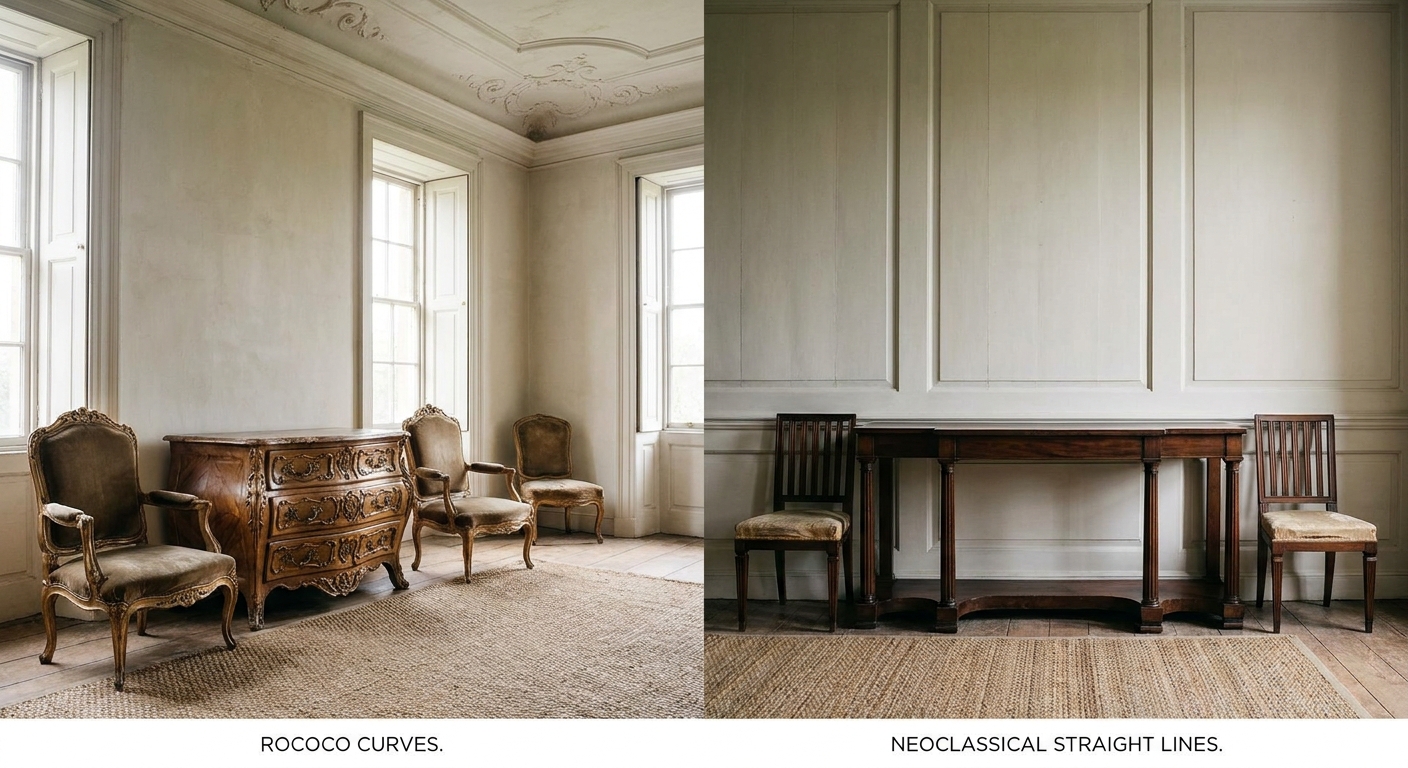
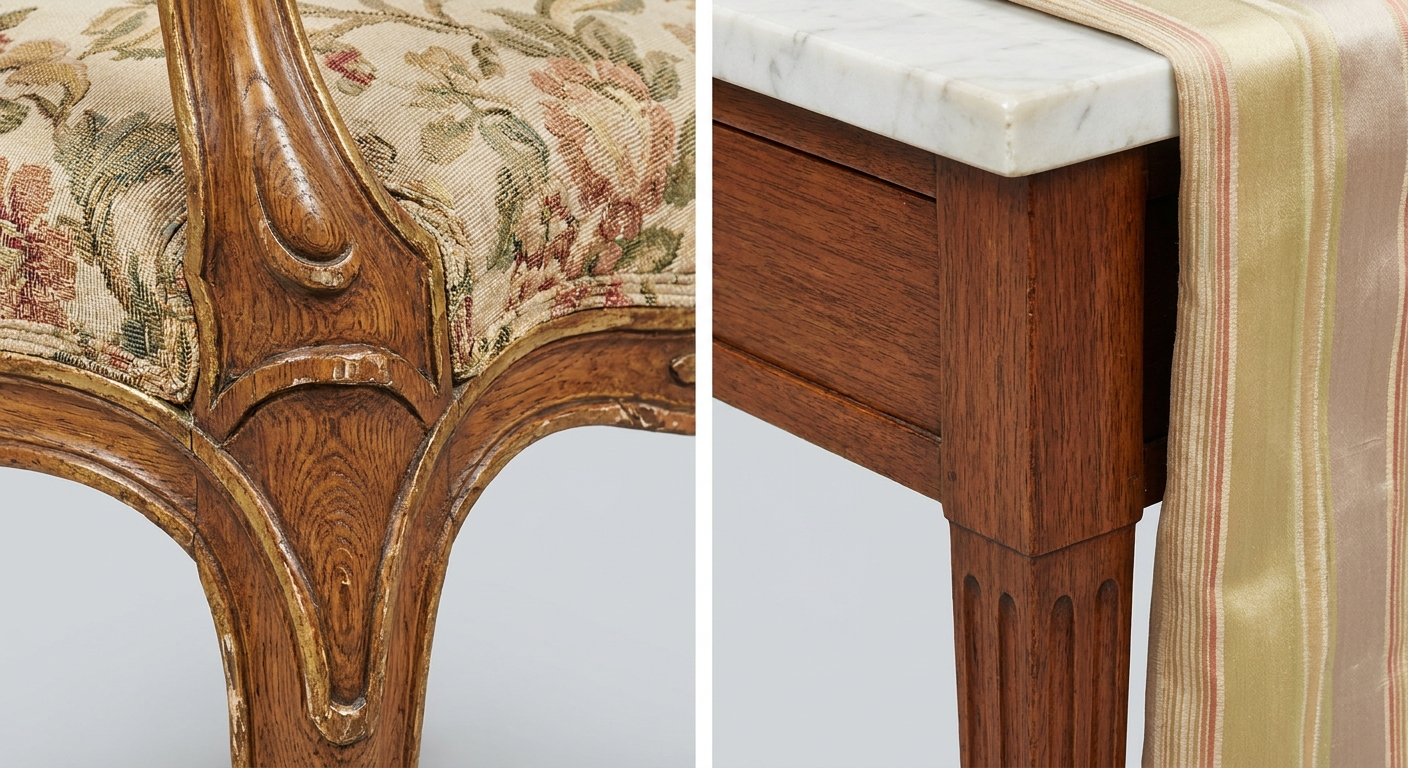
Rococo furniture relies on continuous serpentine lines, asymmetrical silhouettes, and intricate natural motifs carved into pliable woods like walnut to create a sense of weightless movement, while cabinetmakers during the 18th century engineered flowing structures without visible joints to prioritize organic forms over strict mathematical proportions in seating and cabinetry designs.
Wikipedia places Rococo decorative arts in 18th-century Europe and identifies asymmetry, curves, and shell-like ornament as recurring features. Craftsmen achieved fluid shapes by employing cabriole legs, which feature an outward convex curve followed by an inward concave sweep. Seat frames frequently measure between 16 and 17 inches in height to accommodate relaxed, informal postures favored during the reign of Louis XV. Upholstery materials from the 1730s include silk damask and floral brocades tacked directly onto exposed, carved wooden frames.
How do Neoclassical straight lines contrast with Rococo forms?
Neoclassical furniture rejects organic asymmetry in favor of strict geometric proportions, employing straight fluted legs, rectangular silhouettes, and symmetrical ornamentation inspired by ancient Greco-Roman architecture, because furniture builders working after 1760 replaced sweeping curves with precise right angles to establish visual order through measured linear frameworks and restrained decorative elements.
The transition toward Neoclassicism introduced distinct structural requirements for chairs and tables. Cabinetmakers replaced the curved cabriole leg with straight, tapered supports that often feature vertical fluting resembling classical columns. Dining chairs from the 1780s typically maintain rigid 18-inch seat heights, enforcing formal upright postures. Designers incorporated architectural motifs such as urns, festoons, and Greek key patterns into the woodwork. The Victoria and Albert Museum describes Art Deco as an international style that spread during the 1920s and 1930s across architecture, interiors, furniture, and industrial design, which later echoed the strict geometry first popularized by Neoclassical straight lines.
Dimensional differences in seating and cabinetry
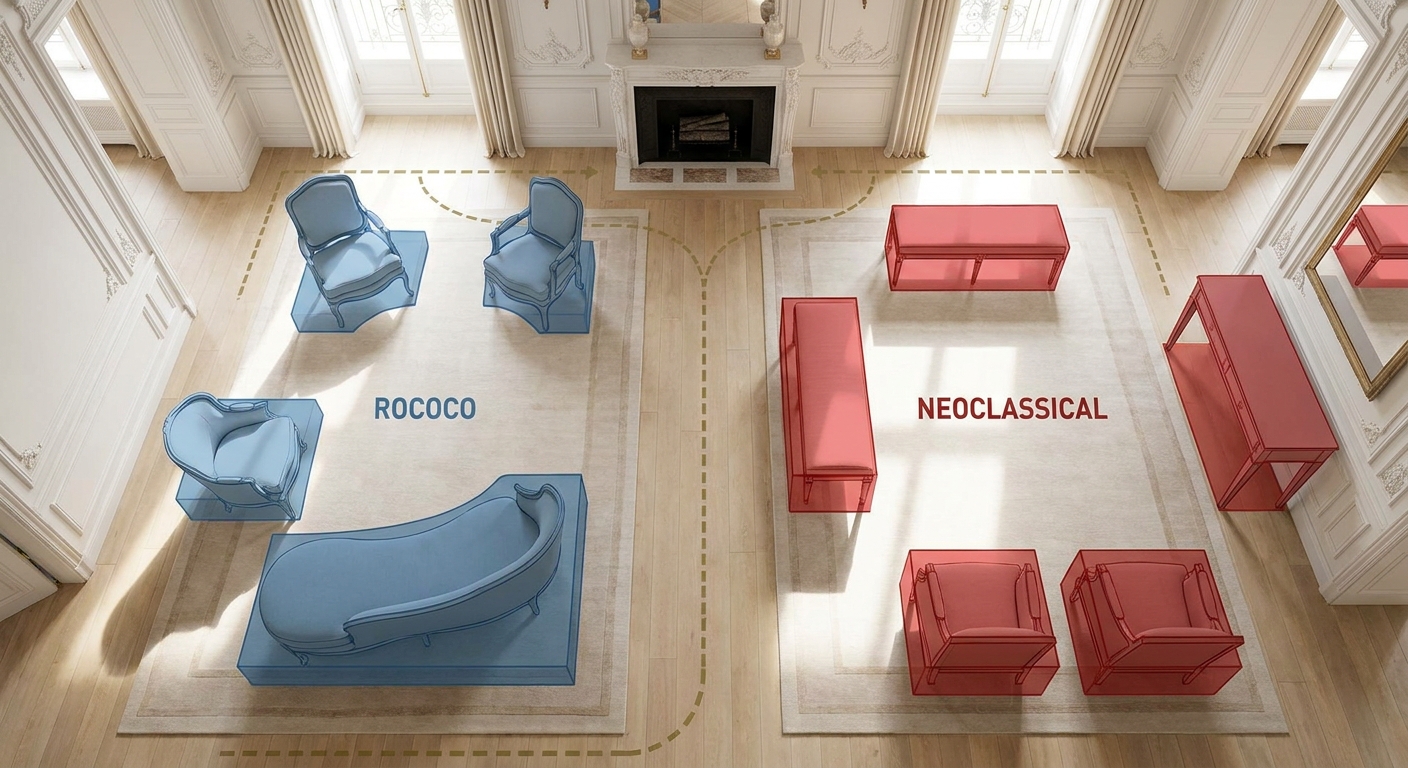
Furniture dimensions provide reliable indicators for distinguishing between the two historical styles. Rococo armchairs feature wide, deep seats measuring up to 26 inches across to accommodate voluminous 18th-century garments. Neoclassical seating narrows the seat width to approximately 22 inches, reflecting a shift toward tailored clothing and formal room arrangements. Cabinetry exhibits similar proportional shifts. Rococo commodes swell outward with bombé shapes extending 24 to 28 inches deep at the center. Neoclassical chests remain strictly rectilinear, maintaining a uniform depth of 20 to 22 inches from edge to edge.
Which materials and finishes distinguish these two historic styles?
Material selection heavily influences the structural integrity and visual impact of historic furniture, with Rococo artisans favoring heavily gilded walnut for intricate carving, while Neoclassical makers preferred lighter mahogany and satinwood for precise geometric veneers, because surface treatments shifted from thick gold leaf applications to restrained marquetry and painted architectural details.
Conservation experts rely on specific material markers to authenticate period pieces. The National Park Service preservation briefs provide source-backed guidance for historic wood, plaster, and paint conservation in buildings under documented preservation conditions. Furniture restorers apply similar guidelines when evaluating 18th-century finishes. Rococo pieces frequently exhibit water gilding over red clay bole, creating a brilliant, reflective surface that highlights deep floral carvings. Neoclassical craftsmen applied contrasting wood veneers, embedding 2-millimeter thick sections of exotic woods into solid mahogany frameworks to create flush, two-dimensional patterns.
Comparative analysis of Rococo and Neoclassical furniture traits
Buyers must evaluate multiple structural and decorative elements simultaneously during furniture selection. The following table outlines the primary differences between the two design movements.
| Design Element | Rococo Furniture Specifications | Neoclassical Furniture Specifications |
|---|---|---|
| Primary Silhouette | Asymmetrical, continuous S-curves | Symmetrical, rectilinear frameworks |
| Leg Structure | Curved cabriole legs ending in scroll feet | Straight, tapered legs with vertical fluting |
| Typical Ornamentation | Carved shells, acanthus leaves, C-scrolls | Inlaid urns, Greek keys, medallions |
| Standard Seat Height | 16 to 17 inches | 18 inches |
Related reading on this site
Readers comparing planning rules can also review Meet Our Team for adjacent context on the same site.
Material and proportion decisions connect closely with About Us, which gives readers another local reference point.